
The Mystery of the Lost Claude Lorrain Painting
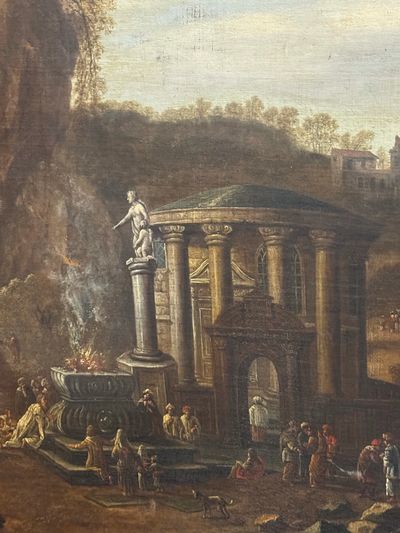
At the museum in a long narrow room with a high ceiling, the young guy looked at it. He seemed both interested and excited. He said none of the museum professionals were available but that he had an associate he would like to call down to study it with him. He said their review might be an hour or two. He asked if we would be interested in a free pass to the museum and a free pass to have anything in their museum restaurant. My mom said yes quickly, and we went off to explore the museum.
As we began our tour of the museum I remember my mom took a teaching moment and said her aunt had explained how Americans view art and how Japanese people view art. She said Americans go to the museum and try to see everything, while the Japanese bring a folding chair and sit for an hour or two, or perhaps the entire day with one piece of art. The American will say, "Saw it all." The Japanese would say they understood the painter and the painting and would be in a position to discuss details and what they really saw.
My mom chose a painting and said “Let’s study this”, and she and I stood with the painting for what was a full ten minutes. I remember this painting, the colors, the fine velvet details. I only remember one other item in the museum, an Egyptian statue of granite of an ancient Egyptian standing. We had lunch and I was impressed I’d never been to a sit down restaurant with my family.
After lunch we went back to the narrow room and our painting. The original guy was there and his partner had joined him. Both were excited. They told us it appeared to be a 17th century European painting done in the style of the painter Claude Lorraine. They said he was French and had spent many years in Italy. They were excited. Their excitement scared my dad. They showed us picture books of Claude Lorraine’s paintings. I could see the similarities. I could see trees, leaves, castles, temples that looked similar. They said it looked like a lost Lorraine. The second young guy asked if we would leave the painting for a month so the museum higher-ups could study it. My dad said, "No." He was being protective of a treasure that had been in our family forever.
Discovering a Lost Painting

Family Acquires the Painting
Dwinal Pride, owner of a horse stable in Westbrook Maine, sometime in the 1850’s bought a large European painting at auction on the Eastern Promenade in Portland Maine. He brought his painting home from Portland and stored it in his attic. I’m presuming he never hung it because the painting was rolled up when my dad inherited it from his grandfather Walter Pride, he was the son of Dwinal Pride. Dad stored the rolled up painting in one of our attics filled with old furniture. I was aware of the painting because I had seen it when my dad Warren Pride brought it home. As kids we played in the attic climbing through and over the furniture. I remember stepping on the rolled up painting as we explored the attic. The canvas side faced outward and sat in that attic for several years.
One day my dad retrieved the painting from its attic. Brought it to his wood shop and glued it down using contact cement. As a carpenter he achieved excellent adhesion with a smooth flat surface. He glued it to a ¼ inch pine sheet. I remember the day he glued it. I remember the smell of the contact cement. Several days later he trimmed the edges with his skull saw because the painting in its rolled up form had ragged edges. After he squared the edges of the painting. He built a wooden frame and painted the frame with dab painting using gray and white paint. I was present for both the gluing and trimming. I did not see him build the frame or paint it. He wanted to frame it to protect it and allow it to be hung up.
Attempted Restoration
While the painting was still in his workshop my dad thought he would try to clean it because he thought it was dark. He took a rag from his paint collection, soaked it in Thinx cleaner, rubbed it on a dark section of the painting on the lower left side. Within seconds he could see it was removing underlying paint.
I had many conversations with my dad about the painting and his thoughts about who had painted it and what it might be worth. He hung the painting in his and my mom’s bedroom. Mother hated the painting. It did not go with her sense of decorating. Our house was elegantly appointed, the painting represented a gash in the aesthetics of the whole house.
My dad was not a talker, he and I though had many conversations about the painting. He felt it had to be worth at least a million dollars. One day in the early 60’s he had bought a blue and white ford station wagon and decided to take the painting to Boston and the Museum of Fine Arts to get a professional opinion about the painting. He didn’t have an appointment we just put the painting into the car and left.
Museum Visit
Museum Visit
In the early 90’s I traveled to South Africa with a dozen jewelers to visit the country. We saw our primary diamond cutter. We visited diamond mines and a platinum mine. As we were traveling around the country we stopped in the city of Kimberly, where they had the abandoned Kimberly diamond mine.
I took a walk one afternoon and came upon an art museum on the outskirts of town. I was surprised that they had an entire room of Claude Lorraine paintings. I recognized them immediately for the layout of the scene, the light, the clouds, the trees, the temples. Claude’s work was recognized without reading the wall tags. I was surprised that this remote museum had so many Claude Lorraine paintings. I recognized them immediately because I had grown up with a Claude Lorraine in our house in Gorham Maine.
I’ve had similar reactions to seeing Claude’s work at the Metropolitan Museum of Art in New York City and the Louvre Museum. It’s like seeing your mom or dad if they had an identical twin that you never knew about. One would immediately recognize the similarities.
The Claude Lorrain Connection
